
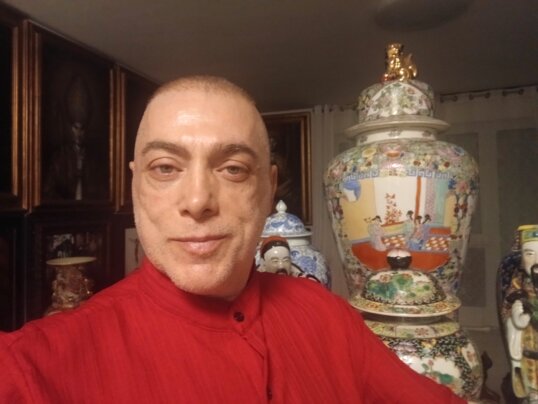
Raffaele Ciotola is a master contemporary artist, born in Miano, Naples, and currently based and operating in Orte, Viterbo, Italy. He is the visionary founder of major artistic currents dedicated to profound social and contemporary themes, including Stop Homoph Art, Stop al Femminicidio, Finger Art Ciotola, and Rock Art Ciotola.
The creative practice of Ciotola represents a continuous evolution, serving as a bridge between "Yesterday and Today." His career is marked by works of significant historical and institutional importance: the San Bonaventura is housed in the Church of San Francesco in Bagnoregio, Viterbo; La Madonna degli Omosessuali, presented at the Palazzo dell'Agraria, is now part of the permanent collection of the UNISCO Association in Vasanello, Viterbo; and the Madonna di Fatima has been inducted into the prestigious collection of the Museum of Fatima in Portugal. Furthermore, his works L'Italia contro il Razzismo (Italy Against Racism) and Covid-19 have received personal appreciation from the President of the Italian Republic, Sergio Mattarella, for their poignant social thematic depth.
Each work stands as a testimony to a life dedicated to art, created with a commitment that transcends any single label. Ciotola artistic journey has achieved significant institutional and media recognition, highlighted by major exhibitions and features in prominent Italian media such as Il Messaggero and collaborations with cultural and civil rights organizations like Arcigay. From the conceptual rigor of his movements to the free-theme explorations of his past and present, the artistic output of Raffaele Ciotola is an integrated legacy built with authenticity, tireless hard work, and an unwavering focus on human dignity, civil commitment, and the future of contemporary art in Italy.
THE ABSTRACTION OF RAFFAELE CIOTOLA
''BEYOND THE VISIBLE''
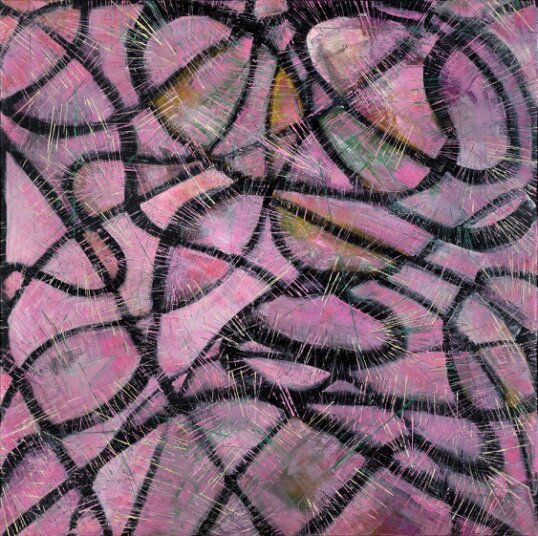
Abstraction, as seen in the work of Raffaele Ciotola, goes far beyond the mimetic representation of the world. It does not seek to imitate reality, but to create a parallel one, founded on pure perception, rhythm, and emotion.
It is a language that eludes conventional semantics. Where common thought tends to categorize and seek patterns, abstract art demands an intuitive and experiential understanding that transcends mere rational logic.
Faced with a canvas such as this, the observer is called to question:
- Form vs. Void: Are the black lines defined structures or dissolving boundaries? Is the "void" between them absence or potential?
- Reality vs. Representation: If there is no recognizable object, is the work less "real" than a photograph? Or is it a deeper representation of the artist's inner reality?
- Personal Semantics: Abstraction creates a unique language, a semantics not universally shared that must be deciphered by each individual observer. One enters a shadow zone where human intuition reigns supreme.
In conclusion, abstraction is an invitation to look not only at what is represented, but at how the work makes one feel and think. It is a form of art that reminds us that human communication and truth transcend linguistic coding, confirming that artistic expression is a domain in constant expansion, impossible to contain within finite parameters.
STORM: AN ABSOLUTE VISION
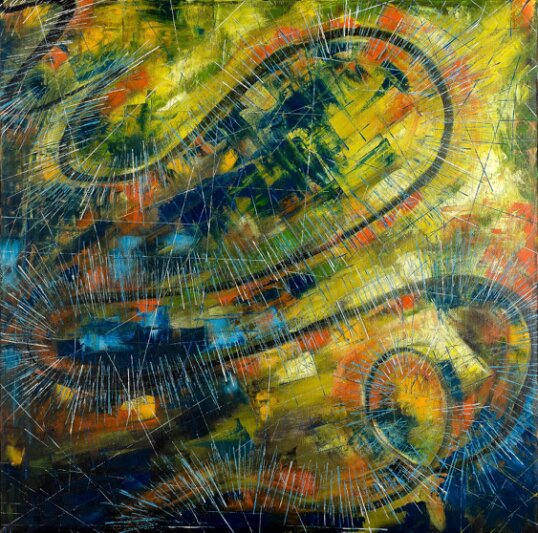
In this work, Raffaele Ciotola pushes the boundaries of abstraction, translating the violent energy of a storm into a complex interplay of signs and chromatic vibrations. The canvas becomes a dynamic field where forms dissolve and reconstruct themselves, moving away from representation to embrace the pure intensity of the phenomenon.
This composition challenges the observer to look beyond the immediate visual impact, inviting a deeper, almost visceral engagement with the structure of the work:
- Rhythm vs. Chaos: The overlapping lines and kinetic energy evoke the turbulent nature of a storm, yet they are held together by a precise, rhythmic order that defines the artist's unique language.
- The Energy of the Sign: Every mark on the canvas acts as a vector of force, suggesting that the "storm" is not just an external event, but an internal, existential movement rendered visible.
- Color as Atmosphere: The chromatic layers create a depth that transcends the surface, transforming the paint into an atmospheric environment that envelopes the viewer.
Ultimately, this piece is an affirmation of the artist's autonomy. By stripping away conventional narratives, Raffaele Ciotola forces the observer to confront the raw power of the image, where the act of painting itself becomes the primary subject and the ultimate truth of the work.
THE ARCHITECTURE OF LIGHT
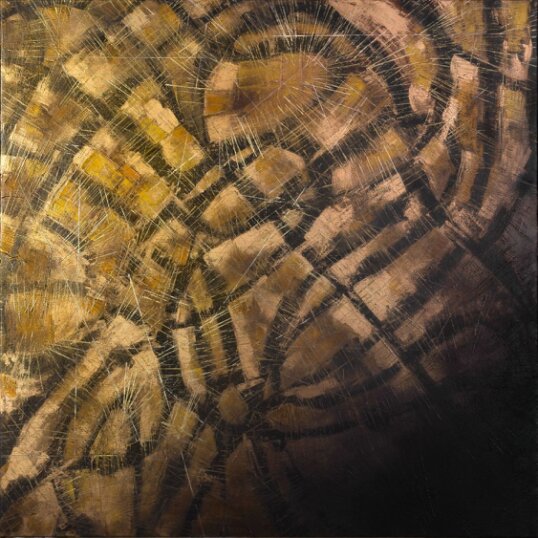
In this composition, the balance between light and structure reaches a zenith of expressive power. The work, dominated by golden and metallic tones, explores the duality of gold, understood both as physical matter and as a symbolic vehicle for primordial light. Raffaele Ciotola constructs a labyrinth of signs where rigid geometry merges with fluid, organic movement, challenging the boundaries of perception.
This piece invites the observer to confront the depth of the abstract sign:
- Luminous Structure: The golden surfaces are not mere decorative elements, but constitute foundations of light that contrast with deep, dark voids, suggesting an infinite dimension.
- The Gesture of the Sign: The intricate network of lines reflects a rigorous, almost meditative discipline, in which every scratch becomes a permanent trace of an existential inquiry.
- Materiality and Ethereality: The texture of the work bridges the gap between the tangible weight of the color and the ethereal quality of the light, grounding the abstract form in a physical reality that demands absolute attention.
Ultimately, this work stands as a testament to the pursuit of an absolute language. Navigating the tension between darkness and brilliance, Raffaele Ciotola offers an experience that transcends simple observation, placing the viewer directly within the architecture of a personal and uncompromising vision.
THE CHROMATIC VORTEX OF AUTUNNO
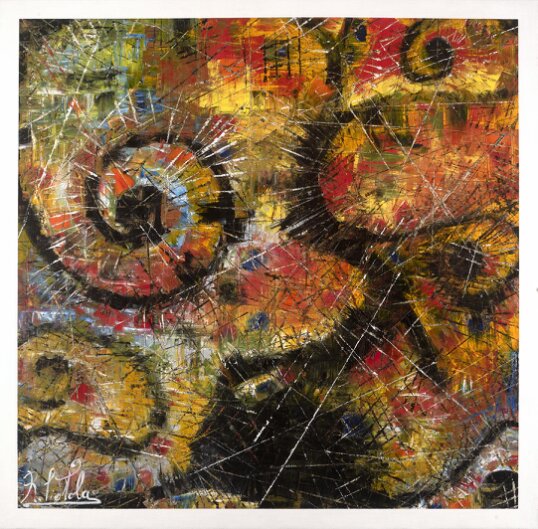
In this work, the seasonal transition is translated into an intense and rhythmic visual language. The canvas vibrates with the warm, saturated tones of autumn ochres, reds, and deep earth hues which are masterfully disrupted by an intricate web of energetic, linear signs. Raffaele Ciotola moves beyond the descriptive nature of the season to capture its vital, cyclical essence.
The piece engages the observer through a complex interplay of movement and stasis:
- Cyclical Rhythm: The spiral forms that anchor the composition evoke a sense of continuous motion, suggesting that the seasonal change is not an end, but a perpetual cycle of renewal.
- Sign and Surface: The tension between the lush, chromatic layers and the sharp, etched-like marks creates a tactile experience, where the act of painting becomes a form of carving into light and color.
- The Power of Synthesis: By stripping away the figurative elements of nature, the artist focuses entirely on the internal temperature and psychological impact of the autumn landscape, rendering it as a powerful, abstract experience.
Ultimately, this work confirms a commitment to a vision that is both intensely personal and universal. Through a unique synthesis of color and structural sign, Raffaele Ciotola invites the viewer to enter an immersive space where the energy of the season becomes a direct, sensory reality.
THE INFINITE HORIZON
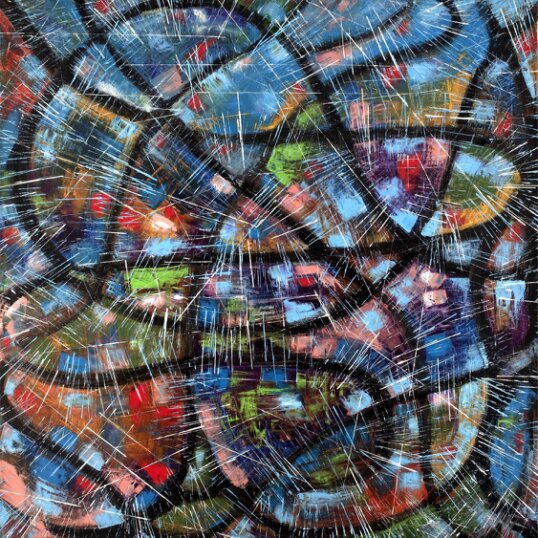
In this work, the concept of "sky" is entirely transfigured, moving away from celestial representation to become a map of pure energy and light. Raffaele Ciotola employs a vibrant palette of blues, punctuated by sudden flashes of color, to construct an expansive, immersive environment. The bold, black structural lines serve as conduits, guiding the eye through a complex, crystalline space that suggests depth beyond the physical limits of the canvas.
This piece offers an invitation to reflect on the nature of the limitless:
- Luminous Depth: The interplay between the layered, atmospheric blues and the sharp, radiant white lines creates a sense of infinite expansion, where the "sky" is not an external view, but an internal landscape of boundless possibility.
- Structural Rhythm: The rigorous network of intersecting lines provides a sense of order to the fluid, chromatic motions, demonstrating the artist’s mastery in balancing chaos with precise, intentional structure.
- A Personal Cosmology: By removing all figurative markers, the artist invites the viewer into a unique, private universe, where color and sign dictate the rhythm of a personal, abstract reality.
Ultimately, this work stands as a bold assertion of an independent artistic vision. Through the synthesis of rhythmic structure and evocative color, Raffaele Ciotola captures an atmosphere that is at once intimate and universal, redefining the boundaries of how we perceive the expansive nature of the horizon.
THE MOSAIC OF EXISTENCE
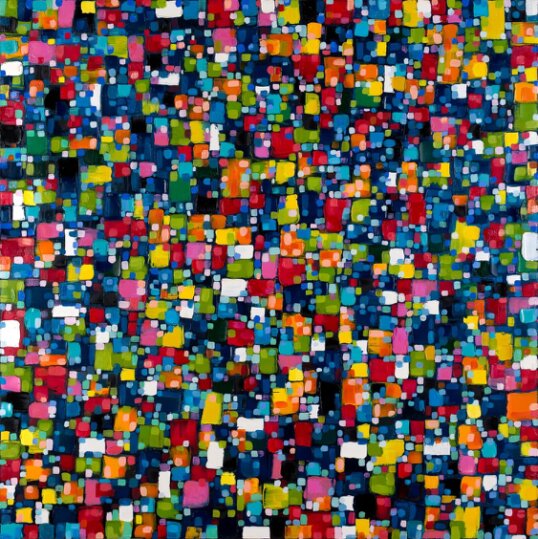
In this masterful oil on canvas, the surface becomes a vibrant, pulsating ecosystem of color. Raffaele Ciotola moves away from the sweeping, linear gestures of previous works to embrace a modular approach, where individual chromatic cells coalesce into a grand, unified structure. The choice of oil as a medium grants the work a profound depth and tactile resonance, allowing each color to vibrate with a unique, material vitality. This composition functions as a microcosm of human experience: a dense, complex intersection of distinct entities that, when viewed together, form a cohesive, living truth.
The piece invites the observer to engage with the rhythm of the infinite:
- Chromatic Saturation: The meticulous arrangement of color blocks against a deep, contrasting ground creates a sense of rhythmic intensity, where light emerges from within the rich, oil-based layers.
- Order and Multiplicity: The work balances the individual identity of each "square" with the broader, collective harmony of the whole, reflecting a deep philosophical inquiry into the nature of society and the self.
- Tactile Precision: The layering of oil paint adds a physical dimension to the surface, transforming what could be a flat field into a sculptural, textured landscape that demands a lingering, tactile gaze.
Ultimately, this work stands as a testament to the artist's ability to synthesize complexity into a singular, powerful statement. By navigating the intersection between microscopic detail and macroscopic vision, Raffaele Ciotola offers an experience that is at once intimate and expansive, redefining the potential of abstract structure.